Marchand · Breast Reduction · Insurance Coverage Check
Carry less. Breathe easier.
Persistent back, neck or shoulder pain from the weight you carry may qualify for an insurance-covered reduction — the same procedure many women assume is entirely cash. In 60 seconds we take a first, private read on your candidacy; where a reduction looks like your path, we check your coverage, build the file, and manage the appeal if one is needed. Coverage depends on your plan and its criteria, and it is never guaranteed — but you shouldn’t have to find that out alone.
Double board-certified surgeonCoverage checked & filed for youBy private consultation · New York
Relief, without carrying it alone.
Double board-certified surgeonThe Aesthetic Society (ASAPS)Accredited surgical facilityWe call your insurer — not just youEvery case reviewed by Dr. Marchand herself
Before Anything Else
Oversized breasts are a real medical condition — not a vanity problem.
Most women living with this kind of pain aren’t looking for a cosmetic change. They’re looking for relief — and many have simply assumed, wrongly, that a reduction is an entirely cash procedure with no path through insurance. When the weight you carry is causing documented back, neck or shoulder pain, a reduction can be a medical conversation, and it may be covered once medical necessity is shown.
You shouldn’t have to choose between living with the pain and paying for relief out of pocket — not before you’ve even asked.
Checked. Documented. Filed. So you’re not doing this alone.
What’s Your Goal?
“Breast surgery” is really several different decisions. Comfort is one of them.
Most women who write to us are certain of one thing — how they feel — and less certain of the path. If large breasts are the reason for pain, this page and its coverage check are for you. If your goal is a different one, naming it honestly is still the useful first step.
Reduction for comfort is a medical conversation, not a cosmetic one — and, unlike augmentation, it may be a conversation your insurance is part of.
More volume
Augmentation
Restore or add fullness, in proportion to your frame. A separate, cash aesthetic path — ask us about it at consultation.
Restore position
A lift
If the concern is drooping rather than size or discomfort, a lift is a different, cash aesthetic path.
Fuller & lifted
Both, together
When volume and position have both changed, an augmentation-lift is a considered cash path, discussed at consultation.
Comfort & relief
Reduce for comfort
If large breasts cause back, neck or shoulder pain, a reduction may be insurance-covered. This page — and its coverage check — is for you.
You are here
Correct a past result
Revise
A previous augmentation that isn’t right is a different operation — one for a revision specialist.
A personal choice
Remove implants
Choosing to have your implants removed is valid and personal — discussed honestly, without pressure, at consultation.
Comfort reduction and aesthetic augmentation are two different journeys.
It saves you time to know, early, which one you’re on — because they are paid for, planned and pursued in genuinely different ways.
This page — comfort reduction
Possibly insurance-covered
When large breasts cause documented back, neck or shoulder pain, a reduction is a medical conversation — and it may be covered by your plan once medical necessity is shown.
A coverage check, built from your symptoms and history
We file the paperwork and manage the appeal if one is needed
Coverage depends on your plan and its criteria — never guaranteed
A different path — aesthetic augmentation
A private, cash decision
Augmentation for fullness and proportion is a cosmetic choice, priced transparently and paid for privately or through financing — a different page, a different conversation.
Not covered by insurance
A transparent, all-inclusive quote, prepared privately
Tell us at consultation and we’ll point you to the right path
What Actually Qualifies
The criteria insurers actually look for — considered plainly.
Every plan is different, and nothing here is a guarantee — but most insurers who cover a reduction are looking for a similar shape of evidence. Here is the honest picture, before you ever fill out a form.
Documented symptoms
Back, neck or shoulder pain — or rashes and grooving under the bra strap — typically documented over 6 or more months.
Conservative treatment tried
Physical therapy, chiropractic care or other non-surgical treatment attempted first, with its results recorded.
Visible evidence
Bra-strap grooving, skin irritation, or photos your clinician can point to alongside your history.
A tissue-removal estimate
Many insurers reference a minimum estimated tissue removal (a “Schnur” guide) relative to your height and weight.
Criteria differ by insurer — Aetna, Cigna, UnitedHealthcare, Anthem and Medicare, among others, each apply their own — and are decided by your plan, never by us.
What We Handle For You
Most clinics tell you to check. We check, file, and fight the denial.
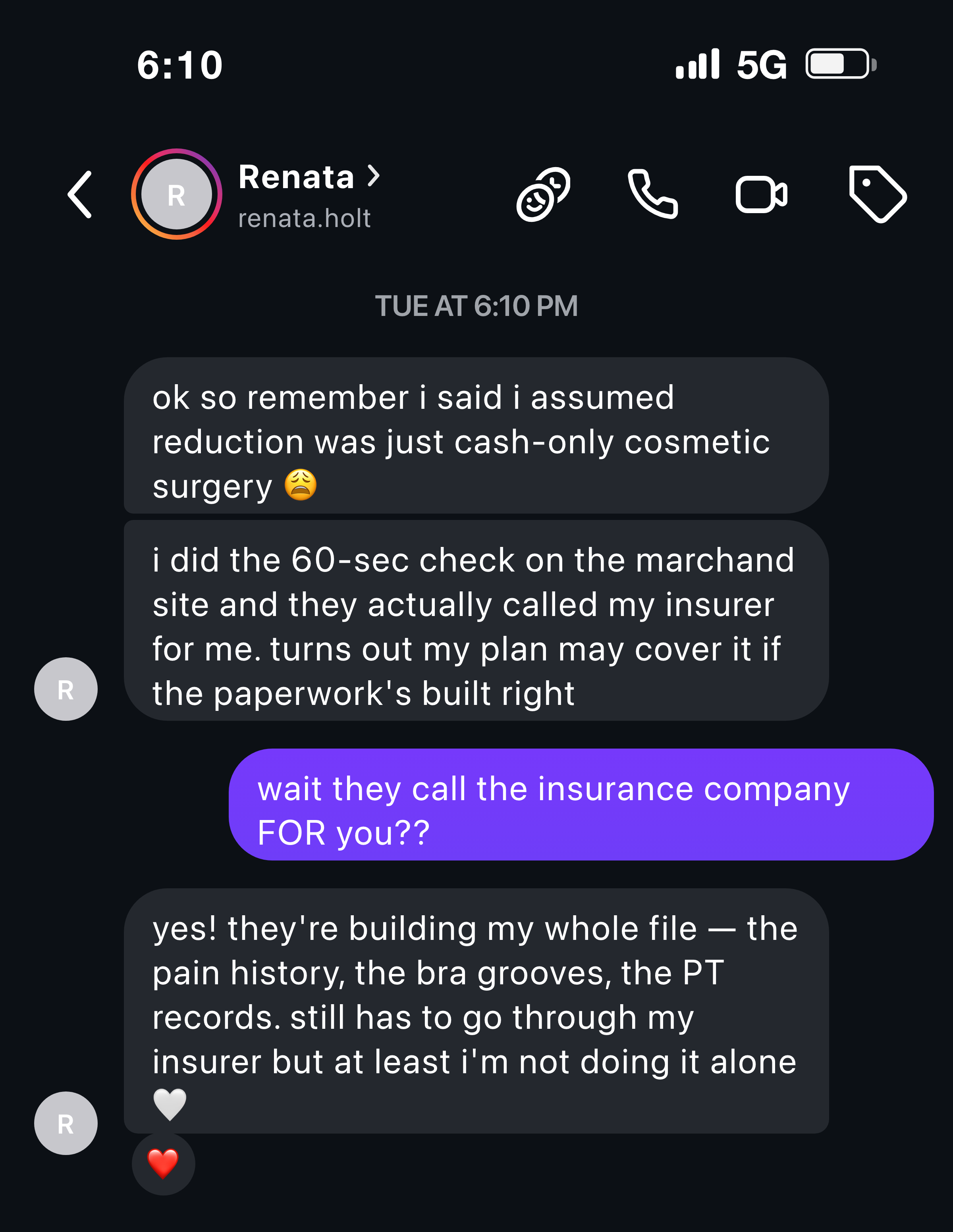
The 60-second check gives a first, considered read on your symptoms and history. If a reduction looks like your path, we don’t hand you a phone number and a form — we build your medical-necessity file and manage it with your insurer directly.
We call your insurer
A member of the practice contacts your plan directly, rather than leaving you to interpret the fine print alone.
We build your medical-necessity file
Your documented pain, any conservative treatment already tried, and the evidence your insurer asks for — organised and submitted for you.
We manage the appeal, if one is needed
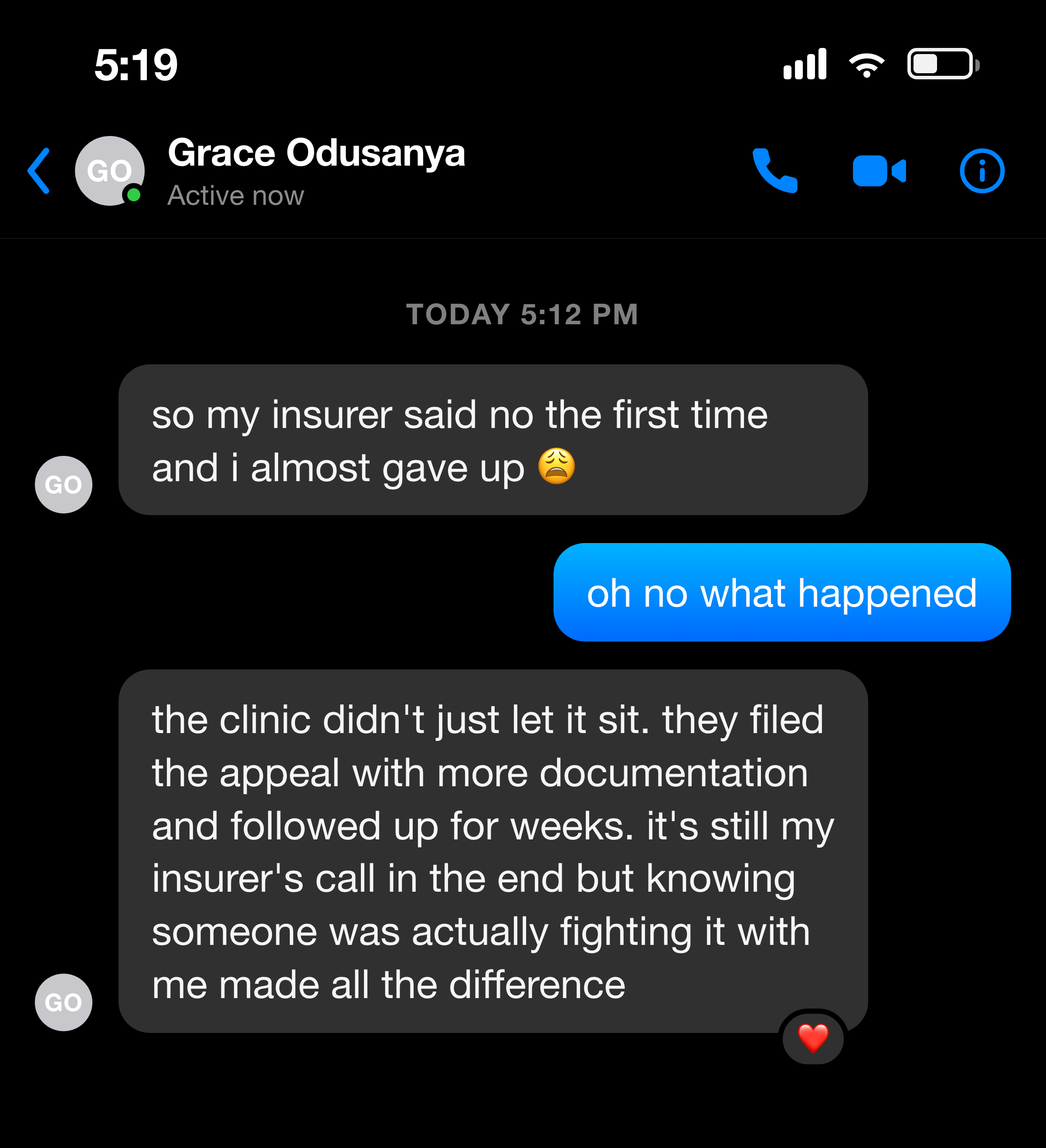
A first “no” is common and is not the end of the road. If your claim is denied, we file the appeal with additional documentation on your behalf.
Honest, every step
We tell you plainly what your plan does and doesn’t make likely. Coverage depends on your plan and its criteria, and it is never guaranteed.
The full range — so you can see exactly where your path sits.
Augmentation
Restored or added fullness, planned to your frame. A separate, cash aesthetic path.
A lift (mastopexy)
Restores position after time or nursing. A separate, cash aesthetic path.
Augmentation-lift
When both volume and position have changed, addressed together. A cash aesthetic path.
ReductionThis page
For comfort from large breasts — a medical conversation that may be insurance-covered.
Revision
Correcting a previous result — capsular contracture, malposition, or an aug that isn’t right. A different operation.
Removal (explant)
Choosing to have implants removed is a valid, personal decision — heard honestly, without pressure.
Meet Your Surgeon
Dr. Élise Marchand
Two decades in breast surgery have taught Dr. Marchand that comfort deserves the same rigor as aesthetics. She confirms candidacy herself, and where a reduction may ease real, documented pain, her practice does the unglamorous work of proving it to an insurer — properly.
Double board-certified in plastic and reconstructive surgery
A caseload kept deliberately small — time for the paperwork, not just the procedure
Reduction is treated as the medical conversation it is — never rushed into a cosmetic frame
Every coverage file reviewed personally before it is filed
“The best outcome isn’t only relief in the mirror. It’s a woman who can finally put her bag down without wincing.”
É. Marchand
A Considered Practice
Judgement earned over a career, applied to a small number of women.
20+
Years in aesthetic & reconstructive breast surgery
2
Board certifications held by Dr. Marchand
1 of few
A limited number of cases accepted each month
100%
Every coverage file reviewed by Dr. Marchand personally
The Aesthetic SocietyAm. Board of Plastic SurgeryASPSRealSelf
Demo · illustrative memberships & recognitions for a Penguin Agents proof build — completed by the practice at onboarding.
Real Relief, Seen Privately
The right question isn’t only how it looks — it’s how it feels to set that weight down.
A curated set of consented patient outcomes is reviewed with you privately at consultation. A representative portrait stands in here; individual results — and any insurance outcome — vary from person to person.
BeforeAfter
Drag to compare.
Illustrative placeholder · your practice’s own consented photos are reviewed privately at consultation · individual results vary · demo.
Check My Coverage
A private breast coverage & candidacy check.
Seven unhurried questions, about a minute. If your answers point to a possible insurance-covered reduction, we’ll tell you plainly what happens next — and if your goal is a different one, we’ll point you to the right path. Nothing is decided, and nothing is billed, until you meet Dr. Marchand.
Where to begin — and whether this could be covered.
This takes about a minute. Your answers stay private and are used only to prepare a considered first read and, if it fits, to start your coverage file.
Question One
What would you most like to achieve?
Choose what matters most to you today. This is the question that shapes everything after it.
Fuller — more volume
A lift — restore position
Both — fuller and lifted
Reduce for comfort
Revise a past result
Remove my implants
Not sure — help me decide
Question Two
What describes your concern best?
A rough sense is plenty. The consultation confirms what is truly at play.
Lost volume or deflation
Sagging or drooping (position)
Too large — back, neck or shoulder discomfort
Asymmetry between sides
A past result I’m unhappy with
Symptoms I attribute to my implants
Not sure
Question Three
How long has this discomfort been going on?
This matters for coverage — most insurers look for symptoms documented over time.
6 months or longer
Under 6 months
Not sure — I’d have to check
Question Four
Where are you with children & breastfeeding?
This matters for timing on any aesthetic path — less so for a comfort reduction, but it helps us plan.
Done — and finished breastfeeding 3–6+ months ago
I may want more children
Currently pregnant or breastfeeding
Not applicable
Question Five
A little more about your history.
Tried conservative treatment (physical therapy, chiropractic, or similar)?
Yes, I’ve tried it
Not yet
Any prior breast surgery or implants?
No — this would be my first
Yes — considering a revision
Yes — considering removal
Question Six
Do you know your insurance carrier?
Only if you know it offhand — we confirm everything directly with your plan.
Aetna, Cigna or similar
BCBS / Anthem or UnitedHealthcare
Medicare or Medicaid
Not sure — help me find out
Question Seven
How are you thinking about timing?
I feel ready to begin
Within the next 3–6 months
I am exploring, unhurried
Reviewing your answers…
Almost there
Where shall we send your read — and your coverage file, if it fits?
We will send your considered read, and — if a reduction looks like your path — begin your coverage check. A member of the practice follows up quietly to confirm next steps.
Your considered read
A board-certified surgeon confirms your candidacy — and any coverage outcome is confirmed only by your insurer — at your complimentary consultation.
Reserve your private consultation
Complimentary · by appointment, New York
Free, no-obligation consultation · select a time on the next step
Reserve Your Consultation
Choose a day and time that suits you.
Complimentary and no-obligation — about 20–30 minutes with Dr. Marchand’s coordinator, by appointment in New York. Availability shown is illustrative for this demo.
Select a day
Select a time
Choose a day above to see available times.
Free & no-obligation · 18+ · Dr. Marchand’s coordinator will confirm by text and email. No surgery, and no coverage decision, is made at this step.
✓
You’re booked.
Dr. Marchand’s coordinator will confirm your consultation by text and email shortly — no action needed from you until then.
What to expect next
A member of the practice confirms your appointment by text and email, usually within one business day.
If your answers point to a likely reduction candidacy, we begin building your coverage file before your visit.
At the consultation: an in-person exam, an honest read on candidacy, and — if you’re pursuing the insurance path — a plain explanation of what we’ve found and what happens next.
This reserves a complimentary, no-obligation consultation — not a surgical booking, and not a coverage decision. Candidacy is confirmed by Dr. Marchand herself, in person, for patients 18 and over. Breast reduction is real elective/functional surgery; individual results vary. Insurance coverage is determined solely by your insurer, based on your plan and its criteria, and is never guaranteed. You may reschedule or step back at any point.
Real Surgery, Honestly
A good surgeon tells you the whole of it — not only the reassuring half.
A reduction is real surgery
General anaesthesia, incisions, and a genuine recovery — not a quick fix. It carries real risks (bleeding, infection, changes in nipple or skin sensation, and a possible effect on future breastfeeding), discussed openly, never minimised to make a sale.
Coverage is never guaranteed
Even a strong, well-documented case can be declined by an insurer, or approved only after appeal. We tell you the honest odds for your specific plan rather than a comforting guess.
If implants are ever part of your path
For women who later consider augmentation, implants are excellent, FDA-cleared medical devices — but not lifetime ones. Capsular contracture, rupture and the rare BIA-ALCL are discussed openly, whenever relevant.
Let’s be honest with each other: whichever path is yours, this is real, considered surgery — it deserves a clear head and the whole truth, which is exactly why we’d rather over-explain than under-tell.
Your Recovery
A real recovery, mapped out plainly beforehand.
A reduction is more involved than augmentation alone, and for most women it is still more manageable than the internet suggests. It is real surgery, so it’s treated with respect — but the timeline is honest, and yours is mapped before you ever agree to a date.
Days 1–7 · the part to plan for
Rest, and noticeably lighter from early on
The first days are the most restricted — no lifting, no strain. Many women notice the physical weight is gone immediately, even while healing; individual, never a guarantee.
Weeks 2–6 · easing back
A steady return, on your own timeline
Gentle activity resumes and settles over the following weeks, with exercise reintroduced on Dr. Marchand’s guidance. Typical ranges, not promises.
Reviewed in person, throughout
You’re never left to guess what’s normal
Dr. Marchand reviews you along the way, so at each stage you know what to expect — surgically, and with your coverage file if one is open.
What To Expect
An honest account of the path, from first question to lasting relief.
The coverage & candidacy check
Your history, considered — and your file, started
You complete the 60-second check. If a reduction looks like your path, we begin building your medical-necessity file before you’ve even met Dr. Marchand.
The consultation
An honest exam, and an honest read
Dr. Marchand confirms candidacy in person and reviews what your file currently shows — plainly, including where coverage looks uncertain.
The coverage decision
Your insurer decides — we keep pushing
Your plan reviews the file. If the answer is no, we file an appeal with additional documentation rather than leaving it there.
Procedure day, and after
Performed by Dr. Marchand, in an accredited theatre
Your reduction is carried out personally, in a fully accredited surgical facility, with your recovery mapped out in advance.
One Woman's Words
“I’d had the grooves in my shoulders for years and just assumed there was nothing to be done about the cost. I did the 60-second check almost as a joke. They called my insurer, built the file, and were upfront the whole time that nothing was guaranteed. My plan actually said no at first — and they filed the appeal without me having to ask twice. I finally know what it’s like to put a bag on my shoulder and not wince.”
R. H. · New YorkVerified patient · shared with permission · demo
Woman To Woman
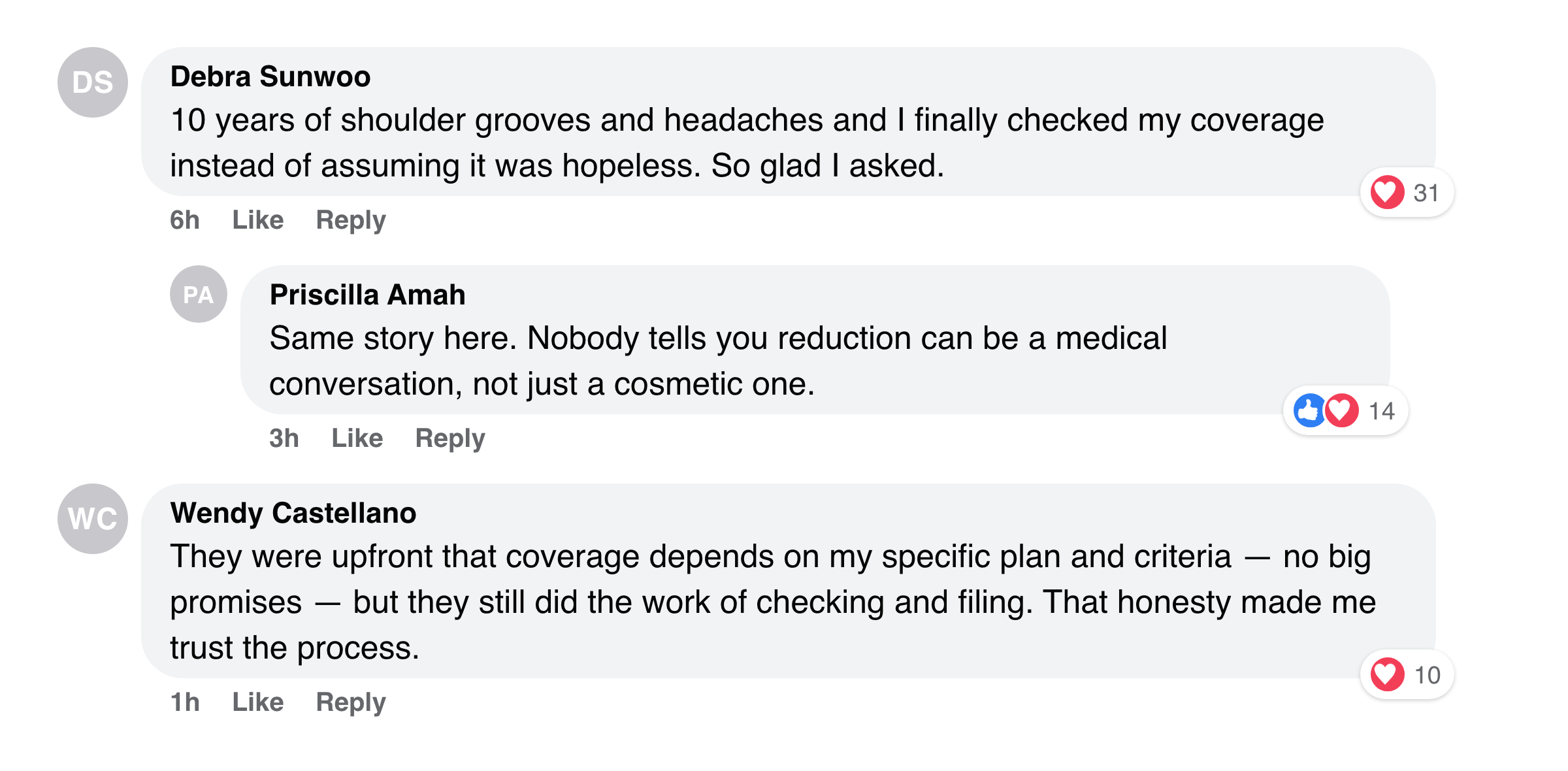
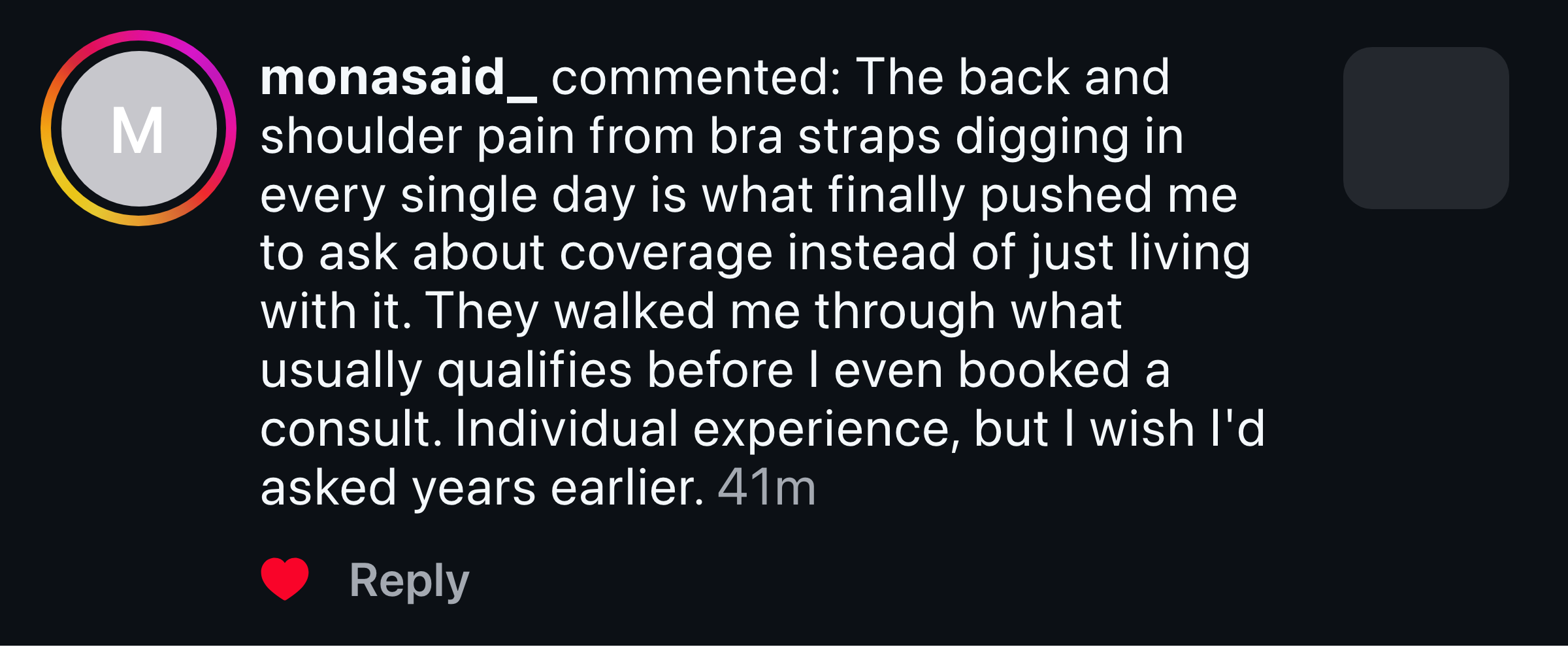
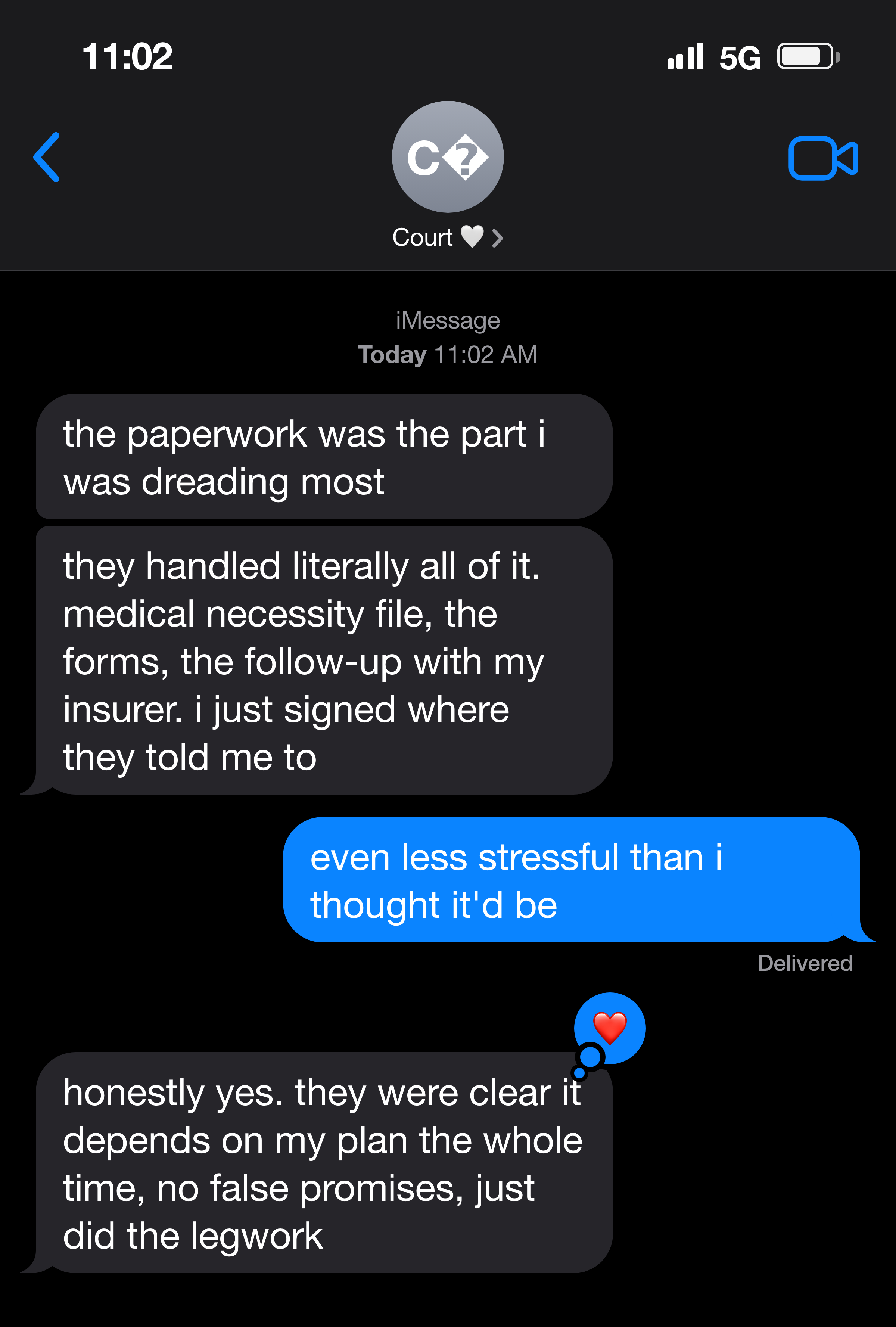
The notes women send once someone finally checked.
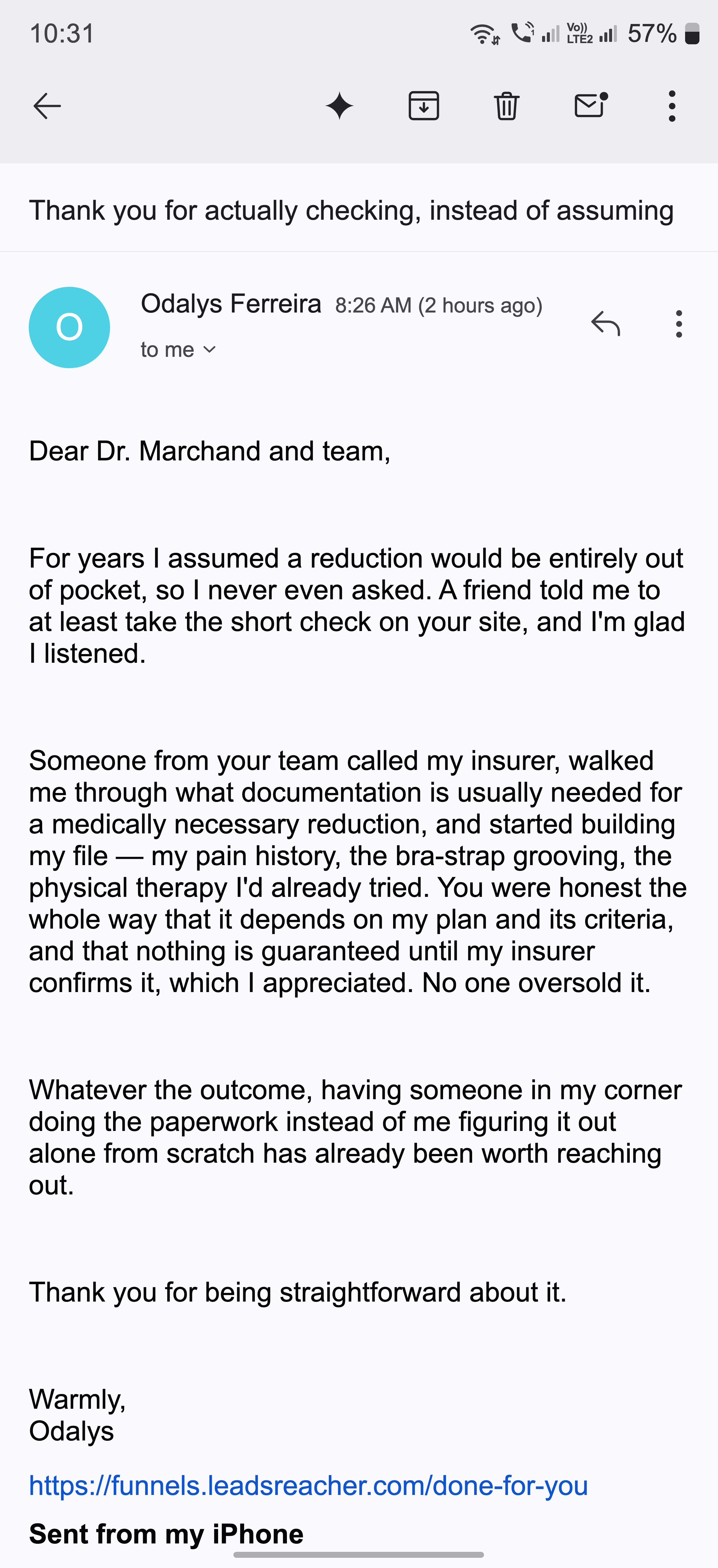
Quiet messages about finding out it might be covered, the honesty about what’s never guaranteed, and the relief of not filing the paperwork alone.
Demo reviews · your clinic’s own verified reviews mount here at onboarding
The Coverage Mechanic
Insurance-covered, when your plan and criteria allow it.
When a reduction is medically necessary and your plan’s criteria are met, many qualifying patients pay significantly less out of pocket than the full cash price — some very little at all. We check your specific plan, build the file, and manage the appeal if one is needed, before you spend anything finding out alone. If coverage isn’t there, a transparent cash price and financing are discussed honestly at consultation — never a surprise either way.
Demo · illustrative. Coverage depends entirely on your plan and its medical-necessity criteria and is decided solely by your insurer — never guaranteed and never implied by this page. No price is quoted here because none can be, honestly, before your plan is checked.
What We Handle
The paperwork isn’t yours to carry alone.
Whether or not your plan ultimately covers it, here is what “done-for-you” actually means at Marchand.
Insurer contact
We call your plan directly to confirm your specific benefits and criteria.
Your medical-necessity file
Documented symptoms, any conservative treatment tried, and supporting evidence — organised for you.
Submission & tracking
Your claim is filed and followed up on our end, not left for you to chase.
The appeal, if needed
A first denial is common and isn’t the end — we file the appeal with additional documentation.
An honest read, always
We tell you plainly what looks likely and what doesn’t, before you commit to anything.
A cash path, if you prefer it
If coverage isn’t the right fit, transparent pricing and financing are discussed at consultation — no pressure either way.
None of this is billed to you as a separate service, and none of it guarantees an outcome. Demo · illustrative process, confirmed by the practice.
If Coverage Isn’t There
If your plan won’t cover it — or a reduction isn’t right for you — Dr. Marchand will tell you so.
The consultation and the coverage check are both complimentary and carry no obligation. If your file comes back uncertain, or a different path (a lift, or simply waiting) would serve you better, you’ll hear that plainly. And if the cash path is the more honest option for your plan, we’ll say so rather than dragging out a file that isn’t going anywhere.
Complimentary, no obligationCandid when coverage looks unlikelyBoard-certified surgeonWe file the paperwork either way
Considered Questions
The questions women actually ask.
What actually qualifies for a covered reduction?
Most insurers look for documented back, neck or shoulder pain (or rashes/grooving under the bra strap) typically over 6 or more months, conservative treatment already tried (physical therapy, chiropractic care), visible evidence like bra-strap grooving or photos, and often a minimum estimated tissue-removal amount relative to your height and weight. Criteria differ by insurer and plan, and coverage is decided by them — never guaranteed here.
Which insurers do you work with?
Commonly Aetna, Cigna, UnitedHealthcare, Anthem/BCBS and Medicare, among others — each with its own criteria and process. We confirm your specific plan’s requirements directly rather than assuming.
What if my claim is denied?
A first denial is common and isn’t unusual. We file an appeal with additional documentation on your behalf. Even then, approval is never guaranteed — it is decided solely by your insurer.
What will this actually cost me?
It depends entirely on your plan. Some qualifying patients pay very little out of pocket; others share a larger portion, or aren’t covered at all. We give you the honest number for your specific plan once it’s known — never a generic quote up front. A transparent cash path is also available if you prefer it or coverage doesn’t come through.
Will I still be able to breastfeed?
Many women can, though it isn’t guaranteed for anyone, with or without surgery. If future breastfeeding matters to you, say so — it’s discussed candidly and factored into technique where possible.
What about scars?
A reduction leaves permanent, though typically fading, scars in a well-established pattern. Dr. Marchand reviews exactly where and what to expect, with photos, at your consultation.
How much recovery are we really talking about?
A reduction is more involved than augmentation alone. Most women plan roughly one to two weeks away from desk work, with a gradual return to fuller activity over the following weeks. It’s real surgery with real anaesthesia and risk; timelines are typical ranges, individual, and never guaranteed.
What if my goal is actually a bigger size, not smaller?
Then this isn’t your page — and that’s useful to know early. Augmentation is a separate, cash aesthetic path with its own transparent pricing; the 60-second check will point you there, and we’re glad to walk you through it at consultation.
How do I know if I’m even a candidate?
The 60-second check gives a considered first read on your symptoms and history. A board-certified surgeon confirms actual candidacy in person, and your insurer alone confirms coverage, at your complimentary consultation.
By Private Consultation
Book your free consultation — and let’s check your coverage.
A quiet conversation about your history, your options, and an honest read on what your plan may cover — with nothing hidden, and nothing guaranteed that shouldn’t be.